Capital Sources
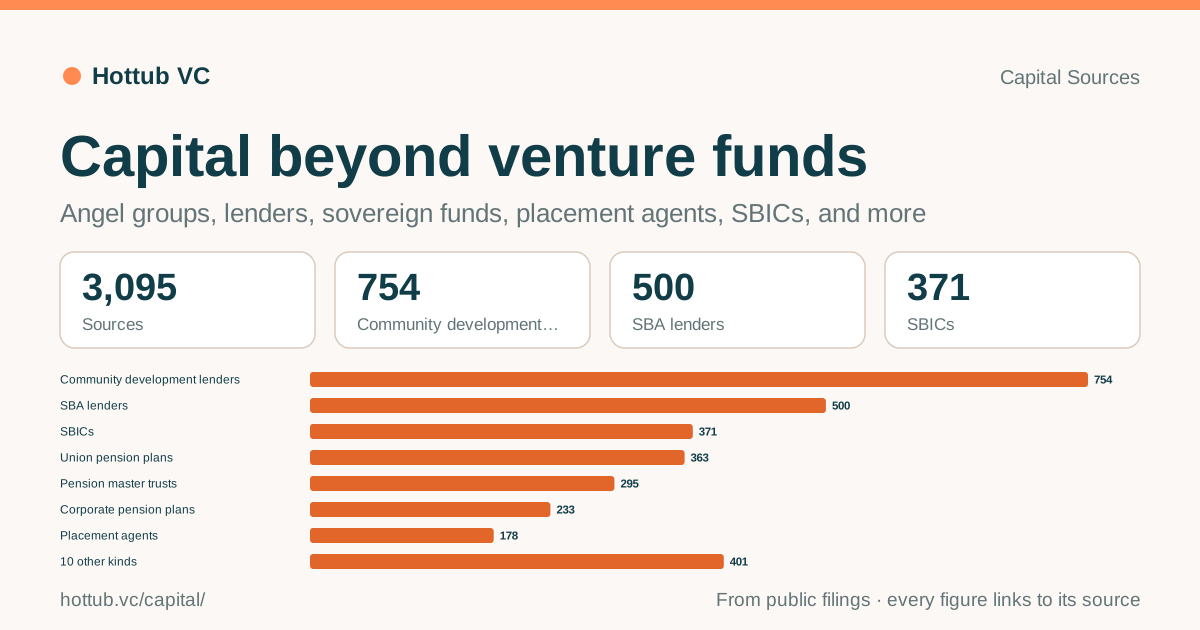
Find the money beyond venture funds: 3,095 sources of capital, from community development lenders, SBA lenders, and SBICs, each from a public record.
- For fund managers. Sovereign wealth funds that back venture funds, the placement agents other venture funds paid, wealth platforms, corporate pension plans, and 3 more.
- For founders. Angel groups, venture debt lenders, revenue-based financing providers, corporate venture arms, and 7 more.
- Know who’s real. Every source comes from a public register or the organization’s own words, linked to where it came from.
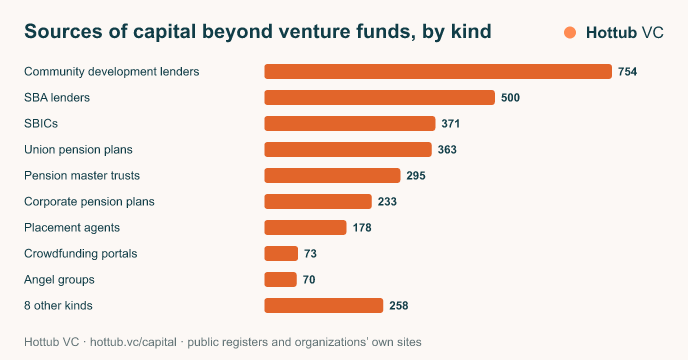
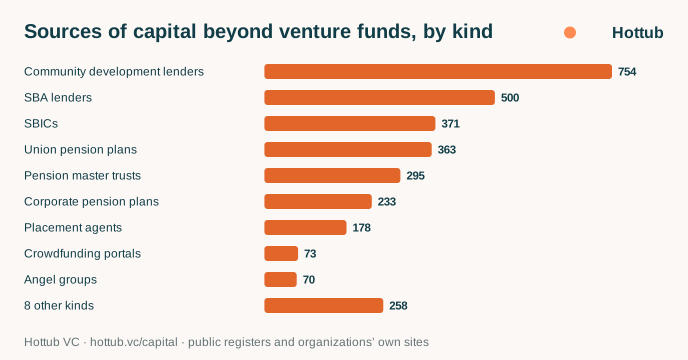
3,095 sources of capital beyond venture funds, in 17 kinds
The numbers
| Kind | Sources |
|---|---|
| Community development lenders | 754 |
| SBA lenders | 500 |
| SBICs | 371 |
| Union pension plans | 363 |
| Pension master trusts | 295 |
| Corporate pension plans | 233 |
| Placement agents | 178 |
| Crowdfunding portals | 73 |
| Angel groups | 70 |
| Corporate venture arms | 66 |
| University venture funds | 46 |
| Venture studios | 43 |
| Sovereign wealth funds | 33 |
| Venture debt lenders | 25 |
| Revenue-based financing providers | 17 |
| Federal R&D grant programs | 17 |
| Wealth platforms | 11 |
Venture funds themselves are in the Venture Capital Fund Index, and the LPs that back them in the LP Directory. Everything in one state: venture capital by state. Angel investors and family offices who list themselves: investors.
What is listed
- Angel groups
Networks of individual investors who hear pitches together and each decide whether to invest. For founders raising a first round, usually tens of thousands to a few million dollars.
- Venture debt lenders
Banks and funds that lend to venture-backed companies, usually alongside or just after an equity round. For founders who want more runway without selling more of the company.
- Revenue-based financing providers
Providers that advance money against future revenue and are repaid as a share of sales, with no equity. For companies with steady recurring or card revenue.
- Corporate venture arms
Venture arms of operating companies, such as technology, pharmaceutical, automotive, energy and financial companies, that invest in outside startups, often ones whose products fit the parent's business.
- Sovereign wealth funds
Investment funds owned by a national or state government, most of which invest in venture through funds rather than directly. For fund managers, some of the largest LPs there are; for founders, mostly a later-stage investor.
- Venture studios
Venture studios and company builders: organizations that start new companies themselves or together with founders, supplying ideas, a team, services and early funding.
- Placement agents
Broker-dealers that venture funds paid to sell their offerings, as the funds reported on Form D. For fund managers deciding whether to hire one, and which firms work with funds their size.
- University venture funds
Venture funds run by or for a university: seed funds, technology-transfer funds and investor networks tied to the university, which back companies from its research, students, staff or alumni.
- Wealth platforms
Platforms and wealth managers that bring wealthy individuals and their advisers into private funds through feeder funds. Each files its feeders with the SEC, which shows how much it has raised and whose funds it carries.
- Corporate pension plans
Defined-benefit pension plans of US companies, hospitals, universities and other private employers that report holding partnership interests directly. They invest in private funds as limited partners, usually through an investment office or an outside adviser.
- SBICs
Small Business Investment Companies: private funds licensed by the US Small Business Administration, which lends them money to invest in small businesses. For founders, a source of debt and equity; for fund managers, the license is itself a way to finance a fund.
- Union pension plans
Multiemployer (Taft-Hartley) defined-benefit pension plans, run jointly by a union and the employers of its members, that report holding partnership interests directly. They invest in private funds as limited partners, usually on the advice of an investment consultant.
- Pension master trusts
A master trust pools the assets of one employer’s pension plans under a single trustee: the plans own shares of the trust, and the trust holds the investments, private funds among them. Most large corporate plans invest this way, so their partnership interests are reported here; plans that hold partnerships directly are listed separately as corporate and union pension plans.
- Crowdfunding portals
Portals registered with the SEC and FINRA to host Regulation Crowdfunding offerings. For founders who want to raise up to about $5 million a year from the public.
- Community development lenders
Loan funds, banks and venture funds certified by the US Treasury’s CDFI Fund as community development financial institutions. They lend to and invest in small businesses that conventional lenders pass over, mostly in low-income communities.
- SBA lenders
Banks and other lenders that make SBA 7(a) loans, the federal government’s main guaranteed loan for small businesses. These are the 500 most active by dollars approved in the latest fiscal year.
- Federal R&D grant programs
The federal SBIR and STTR programs, through which eleven agencies fund research and development at small companies without taking equity. One entry per agency program, with what it awarded in the latest fully reported fiscal year.
| Source | Location | On the record |
|---|---|---|
| Alliance of Angels | Seattle | Seattle angel group whose accredited members fund high-growth technology, hardware, consumer and life science startups in the Pacific Northwest. |
| Angel Academe | London | Mainly female angel network that has invested in female-founded startups since 2014; also runs an EIS fund. |
| Angel Investor Forum | CT | Connecticut angel investor network that meets monthly and invests in pre-seed and seed companies across all verticals headquartered in the United States. |
| Angel One Network | Burlington | Member-based network of accredited investors, established in 2011, funding early-stage startups in Burlington, Hamilton, Toronto and the rest of Southern Ontario. |
| Anges Québec | Montreal | Network of angel investors who fund and get involved in innovative Quebec startups, alongside partner funds. |
| Archangels | Edinburgh | Business angel syndicate, established in 1992, investing in IP-rich technology and life sciences companies in Scotland. |
| Arizona Tech Investors | Phoenix | Phoenix angel investment group funding early-stage Arizona technology startups in software, advanced manufacturing, healthcare, energy and consumer technology. |
| Band of Angels | Menlo Park | Silicon Valley angel group, formed in 1994, that funds seed-stage high-tech and life science companies; also holds a Los Angeles interest group meeting. |
| Beacon Angels | Boston | Boston-based angel group, founded in 2006, that invests in early-stage, fast-growing companies, mostly New England startups. |
| BeAngels | Brussels | Belgian business angel network that connects entrepreneurs with investors for early-stage financing, with groups in Brussels, Louvain-la-Neuve and Luxembourg. |
| Boston Harbor Angels | MA | Angel group investing since 2004 in high-growth, early-stage companies in information technology, life sciences, consumer and business products, and other sectors. |
| Broad Street Angels | Philadelphia | Philadelphia angel investment club, an affinity club of The Union League of Philadelphia, that reviews opportunities in the Mid-Atlantic region. |
| Business Angels Switzerland | Zurich | Association of private individuals who invest time and money in small, newly founded companies with innovative projects. |
| Cambridge Angels | Cambridge | UK business angel network of entrepreneurs, rooted in the Cambridge technology cluster, that has backed more than 150 companies since 2001. |
| Cambridge Capital Group | Cambridge | Business angel network of private investors, family offices and venture funds investing in early-stage technology companies in the UK's Golden Triangle. |
| Capital Angel Network | Ottawa | Canadian angel network whose members invest in early-stage startups and hear more than 50 pitches a year. |
| Central Illinois Angels | Peoria | Peoria-based angel group that has funded and mentored early-stage companies since 2009. |
| Central Texas Angel Network | Austin | Nonprofit, member-based angel investment group in Austin whose roughly 140 accredited investors fund early-stage companies in Texas. |
| Chemical Angels | CA | National angel network providing capital and expertise to seed-stage hard-science ventures in materials, measurement and manufacturing. |
| Citrine Angels | Washington | Washington, DC angel group for women investors that provides early-stage investment to female-founded startups along with investor education. |
| Cowtown Angels | Fort Worth | Fort Worth angel investor network whose members have funded early-stage startups since 2013. |
| DanBAN | Copenhagen | Danish network of private investors who back growth companies, often as the first professional investors in a startup's early stages. |
| Desert Angels | Tucson | Tucson-based network of accredited investors funding early-stage startups through preferred equity and convertible notes, with members nationwide. |
| E8 Angels | WA | Nonprofit angel investment group whose 200-plus members have invested in early-stage climate technology companies across the US and Canada since 2006. |
| Equity Gap | Edinburgh | Angel investment group funding emerging, high-growth, early-stage businesses throughout Scotland. |
| FiBAN | Helsinki | Finnish business angel network whose members invest in startups, organized through local networks across the country. |
| Frontier Angels | Bozeman | Montana angel network with five chapters backing technology-enabled companies in the Rockies and the West, typically at seed stage. |
| Golden Seeds | New York | Angel network with nine chapters that invests in US-based, women-led startups across technology, health care and consumer sectors. |
| Golden Triangle Angel Network | Waterloo | Waterloo Region community of angels, family offices and venture funds investing in Canadian tech companies from pre-seed to Series A since 2008. |
| Gopher Angels | MN | Minnesota angel investment network whose accredited members collaborate to fund scalable, high-growth companies in the Midwest and across the US. |
| Harvard Business School Alumni Angels of Greater New York | New York | Alumni angel group of more than 300 investors that funds startups across 25-plus sectors, including AI, fintech, life science and consumer products. |
| Hawaii Angels | Honolulu | Monthly forum, running since 2002, that connects founders with early-stage angel investors; members fund scalable early-stage companies in and outside Hawaii. |
| HBAN | Dublin | All-island Irish angel network of more than 1,000 investor members and syndicates that has made over 700 investments in companies across sectors. |
| Houston Angel Network | Houston | Nonprofit network of more than 100 member investors that supports Houston founders and startups with capital and mentorship. |
| Hyde Park Angels | Chicago | Chicago early-stage investor that pairs venture capital with a member network of operators; its portfolio includes food, e-commerce logistics and software companies. |
| IrishAngels | IL | Network of University of Notre Dame alumni investing at pre-seed and seed in US companies across fintech, digital health, B2B SaaS, consumer and other sectors. |
| Italian Angels for Growth | Milan | Italian business angel network that gives angels, entrepreneurs and corporates access to venture investments in startups. |
| Keiretsu Forum | San Francisco | Global investment community of accredited angel, venture and corporate investors, founded in the San Francisco East Bay in 2000, with chapters on four continents. |
| Launchpad Venture Group | MA | Network of angel investors, active since 2001, that provides seed funding and mentorship to science and technology startups headquartered in New England. |
| Life Science Angels | CA | Angel group that has invested exclusively in early-stage life science companies since 2005. |
| Maine Angels | ME | Membership organization of accredited investors that funds and mentors early-stage companies in New England, with an emphasis on Maine businesses. |
| Miami Angels | Miami | Membership-based angel network founded in 2013; industry agnostic, focused mainly on post-product, post-revenue early-stage technology companies. |
| Michigan Capital Network | Grand Rapids | Network of angel groups and funds, including Grand Angels, connecting accredited investors with early-stage companies, most of them founded in the Midwest. |
| Mid-America Angels | Overland Park | Regional network of accredited investors, founded in 2006, funding early-stage companies in the Kansas-Missouri region at seed through Series B. |
| Nebraska Angels | Lincoln | Member-led network of accredited investors, founded in 2006, that provides startup capital and connects Midwest entrepreneurs with investors. |
| New Mexico Angels | Albuquerque | Organization of accredited angel investors that has funded New Mexico-based seed and early-stage companies with high growth potential since 1999. |
| New World Angels | Boca Raton | Florida angel network, active since 2003, whose member investors provide seed funding to early-stage companies across the state. |
| New York Angels | New York | Member-led angel group funding early-stage companies in life sciences, SaaS, fintech, consumer products, AI, cleantech and other sectors. |
| North Texas Angel Network | Dallas | Dallas-based angel network of about 70 members that invests in 10 to 15 early-stage companies a year across Texas. |
| NuFund Venture Group | CA | Angel investor group with more than 300 investors that funds technology companies needing up to $1M in venture financing, alongside mentorship. |
| Oxford Innovation Finance | Oxford | Home of the OION angel network and an EIS growth fund; has connected early-stage companies with investors since 1994. |
| Paris Business Angels | Paris | Angel network of about 200 active members that has financed and supported more than 200 startups across France since 2004. |
| Park City Angels | Park City | Group of accredited investors in Park City, Utah, that has made more than 1,200 individual investments in startups since 2008. |
| Pasadena Angels | Pasadena | Nonprofit angel investing group, founded in 2000, whose members provide capital and mentoring to early-stage startups in Southern California. |
| Pipeline Angels | Newark | Network of women and non-binary angel investors that trains new angels and often provides the friends-and-family round for early-stage founders. |
| Plains Angels | IA | Angel investor group that invests in entrepreneurs seeking growth and innovation across the Upper Midwest. |
| Robin Hood Ventures | Philadelphia | Mid-Atlantic angel group investing in early-stage, high-growth startups in software, healthcare IT, hardtech, life sciences and consumer. |
| Rockies Venture Club | Denver | Colorado angel investing network backing seed to Series A companies in technology, cleantech and life sciences, with nationwide syndication. |
| RTP Angel Fund | Research Triangle Park | Member group investing at pre-seed, seed and Series A, mainly in North Carolina's Research Triangle Park region and more broadly in the Southeast. |
| Sacramento Angels | Sacramento | Group of individual investors funding early-stage companies in Northern California and beyond; has invested in more than 150 companies since 2000. |
| Sand Hill Angels | CA | Member-led Silicon Valley angel group of more than 140 investors, active since 2000, that invests in technology startups from seed through Series B. |
| SICTIC | Zurich | Angel investor network that connects investors with Swiss seed and early-stage technology startups. |
| Sierra Angels | NV | Member group founded at North Lake Tahoe in 1997 that funds seed-stage, early-revenue technology companies, preferring capital-efficient enterprise and B2B startups. |
| SWAN Impact Network | TX | Angel investor network funding companies that pursue both social impact and financial return across health, climate, education and equity. |
| Tamiami Angel Funds | FL | Family of angel funds organized to invest in early-stage, high-growth companies in fintech, health tech, edtech and other sectors. |
| TCA Venture Group | CA | Southern California angel organization (formerly Tech Coast Angels) providing seed, bridge and early A-round funding, mainly to California companies. |
| VANTEC Angel Network | Vancouver | Angel network that connects startups seeking funding with investors in British Columbia. |
| VentureSouth | Greenville | Early-stage venture firm that provides capital to Southeastern startups through an angel investment network of more than 500 investors and its funds. |
| Wisconsin Investment Partners | Madison | Angel group of more than 100 investors, founded in 2000, making seed- and early-stage investments across a wide range of industries. |
| Women's Capital Connection | Overland Park | Angel investment network that connects its investors with women-led startup businesses in the Kansas City region. |
| Applied Real Intelligence | FL | Investment manager providing senior secured term loans of up to $30 million to revenue-generating North American startups. |
| Atempo Growth | United Kingdom | Growth lender providing venture debt to high-growth European technology companies from Series A to pre-IPO. |
| Avidbank | San Jose | Commercial bank whose specialty finance offering includes venture lending to high-potential startups, in the Bay Area and beyond. |
| Bootstrap Europe | London | Venture debt firm providing growth debt to technology businesses in Europe, with offices in London, Luxembourg and Zug. |
| CIBC Innovation Banking | Toronto | Bank division providing startup lending, venture debt and fund finance to innovation companies and their investors in North America and Europe. |
| Claret Capital Partners | London | Independent growth debt fund manager that has lent to more than 195 European companies in technology, life sciences and climate tech since 2013. |
| Columbia Lake Partners | London | Provides growth loans to European technology companies. |
| Eastward Capital Partners | West Newton | Provides venture debt financing and venture loans to venture capital-backed technology companies. |
| Escalate Capital Partners | TX | Private credit and growth equity firm investing $5M to $30M in fast-growing later-stage technology, software, services and healthcare companies. |
| First Citizens Innovation Banking | Santa Clara | Innovation banking arm of First Citizens Bank, continuing the Silicon Valley Bank business; provides banking, venture term loans and growth capital loans. |
| Flow Capital | Toronto | Provides growth capital structured as venture debt to high-growth companies in Canada, the US and the UK with at least $3M in revenue. |
| Hercules Capital | San Mateo | Business development company focused on venture lending to venture capital-backed technology and life sciences companies. |
| Horizon Technology Finance | Farmington | Venture lender to technology and life science companies that has provided more than $3 billion in venture debt since 2004. |
| HSBC Innovation Banking | London | HSBC's specialist bank for innovation companies and their investors, with venture debt among its financing; operates in the UK, US, Europe, Israel and Asia-Pacific. |
| K2 HealthVentures | Boston | Provides debt and equity capital to venture and growth stage companies in the life sciences and healthcare industries. |
| Kreos Capital | London | Growth and venture debt provider, now part of BlackRock, that has lent to high-growth companies in Europe and Israel since 1998. |
| Mercury | San Francisco | Financial technology company offering venture debt and working capital loans to startups, originated by Mercury Lending, alongside business accounts. |
| Multiplier Capital | Washington | Technology lending platform providing debt to growing, professionally backed technology companies, typically with revenues above $5 million. |
| River SaaS Capital | OH | Provides venture debt financing to growing US-based B2B SaaS businesses with at least $150K in monthly recurring revenue. |
| Runway Growth Capital | Menlo Park | Provides minimally dilutive debt financing to late and growth stage companies; loans range from $10 million to $150 million. |
| Trinity Capital | Phoenix | Provides senior and subordinated venture debt of up to $100M, plus equipment financing, to high-growth, venture capital-backed companies. |
| TriplePoint Capital | Menlo Park | Global financing platform providing venture debt and equity financing to venture capital-backed companies at every stage of development. |
| Viola Credit | Tel Aviv | Alternative credit manager whose growth lending strategy finances sponsor-backed companies from Series A to IPO, with ticket sizes of $5M to $50M. |
| Western Alliance Bank Innovation Banking | Phoenix | Innovation banking group of Western Alliance Bank offering venture debt term loans, revolving credit lines and asset-based lending to venture-backed companies. |
| Western Technology Investment | Portola Valley | Venture debt provider that has financed more than 1,500 startups across innovation sectors since 1980. |
| 8fig | Miami | Funds Amazon and Shopify sellers in the US and Canada earning at least $12K a month, with no equity required. |
| Bigfoot Capital | CO | Provides non-dilutive loan facilities of $1M to $5M to established B2B software businesses. |
| Capchase | New York | Vendor financing platform for B2B software and hardware sellers: sellers receive booked contract revenue upfront while buyers pay over time. |
| Clearco | Canada | Offers revenue-based financing to direct-to-consumer e-commerce brands, with non-dilutive funding of up to $10 million. |
| Cypress Growth Capital | TX | Provides royalty-based growth capital: funding repaid as a fixed percentage of monthly revenue until a predetermined cap is reached. |
| Efficient Capital Labs | NY | Provides non-dilutive growth capital to SaaS and AI companies, aligned with their recurring revenue. |
| Flexible Capital Fund | Montpelier | Offers subordinated debt and revenue-based financing to growing New England companies in sustainable agriculture, food systems, forest products and clean technology. |
| Founderpath | TX | Provides non-dilutive capital to software, CPG and brick-and-mortar founders through revenue financing, term loans and merchant cash advances. |
| Founders First Capital Partners | San Diego | Offers revenue-based, hybrid and term loans of up to $2M, plus advisory support, to service-based B2B and B2G businesses with $500K to $10M+ in revenue. |
| Gilion | Sweden | Offers non-dilutive growth funding to SaaS businesses and scaleups, using an AI-based analytics platform. |
| Karmen | Paris | French provider of non-dilutive short-term loans of 1 to 24 months for SMEs, with decisions based on company data; has taken over Silvr's activities. |
| Lighter Capital | WA | Provides non-dilutive revenue-based and term debt financing of up to $10M to SaaS and tech startups, without taking equity or board seats. |
| Onramp Funds | Austin | Funds US e-commerce sellers with at least $10,000 in monthly sales, offering up to $2M with revenue-based or fixed repayment. |
| re:cap | Berlin | Berlin financing platform that arranges non-dilutive debt facilities for companies, including growth lending and working capital finance. |
| SaaS Capital | Seattle | Lender focused solely on SaaS, providing non-dilutive growth debt to SaaS and subscription AI application companies with $3 million or more in ARR. |
| TIMIA Capital | Toronto | Provides non-dilutive debt capital to B2B technology companies in the US and Canada with $2 million to $20 million in annual recurring revenue. |
| Wayflyer | Dublin | Provides financing from $10k to $20m to e-commerce, retail, software and services businesses, with no personal guarantees. |
| Allianz X | — | Strategic investment arm of the Allianz Group; invests in mature digital companies in fields relevant to insurance and asset management. |
| American Family Ventures | — | Assets under management (over, as stated): $700M |
| Amex Ventures | — | Venture arm of American Express; invests in startups whose technology is strategically relevant to its card, payments and commerce business. |
| Aramco Ventures | Dhahran | Committed capital: $7.5B |
| Atlassian Ventures | — | Venture arm of Atlassian; invests in companies working on AI, cloud software and the way teams work, from seed to growth stage. |
| Bertelsmann Investments | — | Bertelsmann's global venture capital activities and its Bertelsmann Next growth unit; invests in companies and venture funds across stages. |
| Blue Venture Fund | — | Venture funds owned and capitalized by participating Blue Cross Blue Shield companies; invest in healthcare technology, services and clinical companies. |
| BMW i Ventures | CA | Assets under management (over, as stated): $1.1B |
| Boehringer Ingelheim Venture Fund | — | Evergreen fund of Boehringer Ingelheim, established in 2010; a seed and Series A investor in first-in-class therapeutics, mainly pre-clinical. |
| Bosch Ventures | Stuttgart | Robert Bosch Venture Capital, the venture arm of Bosch; invests in deep-tech companies worldwide, mainly at early stage. |
| Capital One Ventures | McLean | Strategic investor of Capital One; invests in startups in data, technology and financial services that relate to Capital One's business. |
| Cemex Ventures | — | Corporate venture capital and open innovation unit of Cemex; invests in, accelerates and partners with construction-industry startups worldwide. |
| Cisco Investments | — | Cisco's corporate venture group; invests in enterprise technology startups and in venture funds from offices in several countries. |
| Comcast Ventures | New York | Venture arm of Comcast; backs early to growth stage companies in data and AI, energy, future of work, health, property and sports technology. |
| Databricks Ventures | San Francisco | Venture arm of Databricks; takes minority positions in early- to growth-stage data, analytics and AI companies in rounds led by institutional investors. |
| Dell Technologies Capital | — | Venture investment team of Dell Technologies; leads early-stage rounds in enterprise technology companies in the U.S., Israel and Europe. |
| Echo Health Ventures | — | Strategic investing platform formed by a group of health plans; makes venture and growth equity investments in healthcare companies. |
| EDP Ventures | — | Venture capital arm of the energy company EDP; takes minority positions in early-stage energy technology startups, from seed to Series B. |
| ENGIE New Ventures | — | Corporate venture arm of the ENGIE Group, founded in 2014; invests in cleantech startups working on the energy transition. |
| Equinor Ventures | — | Equinor's corporate venture capital arm; makes minority equity investments in early-phase and growth energy companies. |
| GM Ventures | — | Venture arm of General Motors; invests in startups whose technology can be used in GM's vehicles, manufacturing plants and operating businesses. |
| GV | — | Assets under management (over, as stated): $13B |
| Henkel Ventures | — | Corporate venture capital arm of Henkel; invests in early-stage startups, up to Series B, with a focus on sustainability and digital technology. |
| Hitachi Ventures | — | Assets under management (over, as stated): $1B |
| HP Tech Ventures | — | Corporate venture arm of HP Inc., launched in 2016; typically invests at Series A and B and partners with startups at all stages. |
| HubSpot Ventures | — | Venture arm of HubSpot; invests globally from seed through Series B in software companies relevant to HubSpot's customers. |
| Intel Capital | — | Intel's corporate venture capital firm, founded in 1991; leads early-stage investments in AI and deep tech across cloud, devices, frontier and silicon. |
| JLL Spark | San Francisco | Venture arm of the real estate company JLL; invests in early-stage technology startups serving commercial real estate. |
| Johnson Controls Ventures | — | Corporate venture capital arm of Johnson Controls; invests in startups and venture funds and gives them access to the company's resources and customers. |
| Kaiser Permanente Ventures | Oakland | Strategic venture investor of Kaiser Permanente, founded more than 25 years ago; invests in healthcare companies. |
| Lam Capital | — | Venture arm of Lam Research; invests at all stages in companies in semiconductors, digital manufacturing and related industries. |
| LG Technology Ventures | — | Venture arm of the LG Group, founded in 2018 and based in Silicon Valley; invests in early- and growth-stage companies in AI, biotech and cleantech. |
| Lockheed Martin Ventures | — | Evergreen fund size: $1B |
| M Ventures | Amsterdam | Strategic corporate venture capital fund of Merck KGaA, Darmstadt, Germany; invests in biotechnology and technology companies. |
| M12 | — | Microsoft's venture capital fund; invests in seed through Series B technology companies selling to enterprises. |
| MassMutual Ventures | — | Multistage venture firm whose sole limited partner is MassMutual; invests in enterprise software, cybersecurity, fintech, digital health and climate technology. |
| McKesson Ventures | San Francisco | McKesson's venture fund; invests in venture and growth stage companies building software and services for healthcare and pharma. |
| MS&AD Ventures | Menlo Park | Corporate venture capital firm of MS&AD Insurance Group Holdings; invests mainly in early-stage companies in insurtech, fintech, health care and related fields. |
| Nasdaq Ventures | — | Nasdaq's venture investing program for financial services technology; typically leads or co-leads seed, Series A or Series B financings. |
| National Grid Partners | — | Corporate venture and innovation arm of the utility National Grid, launched in 2018; invests in energy and information technology startups. |
| Nationwide Ventures | — | Venture arm of Nationwide; invests in early-stage startups in insurance and financial services. |
| NGP Capital | — | Venture capital firm whose limited partner is Nokia; backs B2B technology companies from Series A onward. |
| Novartis Venture Fund | — | Committed capital (over, as stated): $750M |
| NTT DOCOMO Ventures | — | Corporate venture capital arm of the NTT Group; invests at all stages, mainly early and growth, in startups it can work with across the group. |
| NVentures | — | NVIDIA's venture capital arm; invests in companies advancing areas such as AI infrastructure and robotics. |
| Okta Ventures | — | Venture arm of Okta; co-invests alongside lead investors at all stages and does not lead rounds. |
| Optum Ventures | — | Assets under management (over, as stated): $2B |
| Porsche Ventures | — | Porsche's venture capital arm, active since 2016; an early-stage investor in industrial technology, energy transition and mobility. |
| Prosus Ventures | — | Early-stage venture investing arm of Prosus; invests in sectors next to ecommerce, such as food delivery, fintech and consumer services, and in AI startups. |
| Qualcomm Ventures | — | Qualcomm's venture arm, investing for more than 25 years; backs early to growth stage companies in AI, automotive, mobile, enterprise and smart systems. |
| Salesforce Ventures | San Francisco | Venture arm of Salesforce; invests from seed through growth stage in enterprise software companies, using an evergreen funding model. |
| Samsung Next | — | Corporate venture arm of Samsung Electronics; invests at all stages in AI, robotics, health, hardware, deep tech and software. |
| Sanofi Ventures | — | Corporate venture capital arm of Sanofi; invests globally in biotech and digital health companies from seed to Series B and beyond. |
| SE Ventures | — | Committed capital (over, as stated): $1B |
| Siemens Energy Ventures | — | Venture unit of Siemens Energy, founded in 2020; pilots technology with startups and invests in them across the energy and industrial sectors. |
| Sony Innovation Fund | — | Assets under management (over, as stated): $430M |
| Swisscom Ventures | Switzerland | Venture arm of Swisscom; invests in Swiss and international digital technology companies from seed to Series C. |
| TDK Ventures | San Jose | Assets under management: $500M |
| Toyota Ventures | Los Altos | Toyota's early-stage venture capital arm; invests in deep tech and climate tech, including AI, robotics, mobility, materials and energy. |
| Unilever Ventures | — | Venture capital and private equity arm of Unilever; invests in beauty and wellness brands, commerce and technology. |
| Verizon Ventures | — | Verizon's venture arm; a strategic investor in early-stage technologies that are three to five years from implementation. |
| Wayra | — | Telefónica's corporate venture capital and open innovation platform; invests in AI, connectivity and cybersecurity startups. |
| Workday Ventures | — | Workday's venture capital fund for enterprise technology companies, which it connects with Workday's customers, partners and employees. |
| Woven Capital | — | Fund size across two funds: $1.6B |
| Z Venture Capital | Tokyo | Venture capital arm of LY Corporation (LINE Yahoo); invests in startups and supports them with the group's resources. |
| Zebra Ventures | — | Corporate venture capital arm of Zebra Technologies; invests in early-stage companies that digitize and automate frontline business operations. |
| Abu Dhabi Investment Authority | Abu Dhabi | Abu Dhabi's sovereign investor; its private equity department invests directly in mature and growth-stage companies and through funds run by private equity firms. |
| ADQ | Abu Dhabi | Strategic investment vehicle for the Government of Abu Dhabi and one of the region's largest holding companies; describes itself as an active investor focused on long-term returns. |
| Alaska Permanent Fund | Juneau | $88.98B in assets |
| Alberta Heritage Savings Trust Fund | Edmonton | C$31.9B ($23.3B) in assets |
| Bahrain Mumtalakat Holding Company | Manama | $19.2B in assets |
| Bpifrance | Maisons-Alfort | €21.5B (funds of funds) ($25.3B) in assets |
| China Investment Corporation | Beijing | US$1.57T in assets |
| Emirates Investment Authority | Abu Dhabi | The UAE federal government's sovereign wealth fund, established in 2007; holds strategic stakes in UAE companies and a global portfolio placed with external fund managers. |
| Future Fund | Melbourne | A$289.7B ($200B) in assets |
| Future Ireland Fund | Dublin | €12.7B ($14.9B) in assets |
| GIC | Singapore | Manages most of the Singapore government's financial assets; its private equity group invests directly and through funds, covering buyouts, venture capital and special situations. |
| Government Pension Fund Global | Oslo | NOK 22,683B ($2.29T) in assets |
| Hong Kong Investment Corporation | Hong Kong | Wholly owned by the Hong Kong government, with HK$62 billion of initial capital across four portfolios, including a Strategic Tech Fund and a Co-Investment Fund; invests as patient capital. |
| Hong Kong Monetary Authority Exchange Fund | Hong Kong | HK$4,161.2B ($535B) in assets |
| Ireland Strategic Investment Fund | Dublin | €16.1B ($18.9B) in assets |
| Jada Fund of Funds | Riyadh | Riyadh fund of funds owned by Saudi Arabia's Public Investment Fund; backs venture capital, private equity and private debt funds and lists its portfolio funds on its site. |
| Khazanah Nasional | Kuala Lumpur | RM156B ($38.4B) in assets |
| Korea Investment Corporation | Seoul | US$232.0B in assets |
| Kuwait Investment Authority | Kuwait City | Kuwait's sovereign fund, managing the General Reserve Fund and Future Generations Fund; invests mostly through external fund managers, including in private equity, real estate and infrastructure. |
| Mubadala Investment Company | Abu Dhabi | AED 1,414B ($385B) in assets |
| National Investment and Infrastructure Fund | Mumbai | Fund manager anchored by the Government of India; its Private Markets Fund commits to growth equity, buyout and venture capital funds run by Indian managers, which it names on its site. |
| New Mexico State Investment Council | Santa Fe | >$71B ($71B) in assets |
No sources match. Try a shorter search or clear the filters.
About the data
A sovereign wealth fund is an investment fund owned by a national or state government; most invest in venture through funds rather than directly, which makes them LPs to court more than investors to pitch.
Angel groups, venture debt lenders, and revenue-based financing providers. Compiled by hand from what each organization publishes about itself; every listing links the page its description comes from. Check sizes are shown only where the organization states them. Last checked October 11, 2026.
Corporate venture arms. Venture arms of operating companies, such as technology, pharmaceutical, automotive, energy and financial companies, that invest in outside startups, often ones whose products fit the parent's business. Compiled by hand on 2026-10-11 from each organization's own website; no directory or ranking was copied. source_url is the page on the organization's site that was fetched that day and that the summary rests on. The summary is our own sentence. Facts repeat what the site says: the parent company, the stages it invests at, and a check size only where the site gives one. City, state and country are given only where the site states a single home; where it lists several offices they are in the facts instead. figure_usd is a fund size, committed capital or assets-under-management figure the organization states in US dollars on its site, with figure_label saying which; figures stated in other currencies are left in the facts unconverted, and amounts invested to date are facts, not figures. Nothing is estimated. Left out: arms whose pages could not be fetched, answered with a block page, or showed no sign of an update since 2024. As of October 11, 2026. Source: Websites of the corporate venture arms listed.
Sovereign wealth funds. Compiled by hand from what each fund publishes about itself; every listing links the page its description comes from. Assets are as the fund states them, in its own currency and in US dollars, with the date and the source on its page. Last checked October 11, 2026.
Venture studios. Venture studios and company builders: organizations that start new companies themselves or together with founders, supplying ideas, a team, services and early funding. Compiled by hand on 2026-10-11 from each organization's own website; no directory or ranking was copied. Listed are organizations that describe themselves on their site as a venture or startup studio, venture builder, company builder, venture creator, incubator that creates its own companies, or as building or founding companies alongside investing. source_url is the page on the organization's site that was fetched that day and that the summary rests on. The summary is our own sentence. Facts repeat what the site says about sectors, what it provides, and the funding it commits per company, where it says so. City, state and country are given only where the site states them. figure_usd is a fund size, capital backing or assets-under-management figure the organization shows in US dollars on its site, with figure_label saying which; figures in other currencies are left in the facts unconverted. Nothing is estimated. Left out: studios that work only for corporate clients, sites that could not be fetched, and sites with no sign of an update since 2024. As of October 11, 2026. Source: Websites of the venture studios listed.
Placement agents. Firms that venture capital funds named on Form D as paid to sell their offerings (the form’s sales compensation item), in every filing through 2026-09-30. Firms only: a recipient counts as the broker-dealer it is associated with, by that firm’s CRD number, or under its own name when it has a CRD number and the name is a business’s; individuals are never listed. A fund is an offering by a pooled investment fund that calls itself a venture capital fund; funds registered under the Investment Company Act, single-deal vehicles, feeders, and series are left out, and parallel vehicles of one fund count once. Listed firms were named by at least 2 venture funds on filings since 2015. Funds served counts every venture fund that named the firm since 2008; recent means on a filing since 2021-09-30. The median is of what those funds reported raising. States are the ones the firm solicited in for the most funds, when a filing named states and not all of them. Being named here means a fund reported paying the firm; it is not a recommendation, and a firm may sell far more than venture funds. As of September 30, 2026. Source: SEC Form D data sets.
University venture funds. Venture funds run by or for a university: seed funds, technology-transfer funds and investor networks tied to the university, which back companies from its research, students, staff or alumni. Compiled by hand on 2026-10-11 from each fund's own website or its page on the university's site; no directory or ranking was copied. Listed are funds, investment companies and investor networks run by a university or its foundation, owned or anchored by one or more universities, or operating under a stated agreement or affiliation with one. source_url is the page that was fetched that day and that the summary rests on. The summary is our own sentence. Facts repeat what the site says: the university, who is eligible, and the check size where stated. City, state and country are given only where the site states them (country also where the site is the university's own or the company's national registration is plain from it). figure_usd is a fund size or assets figure stated in US dollars on the site, with figure_label saying which; amounts in other currencies, including Canadian and Australian dollars, are left in the facts unconverted. Nothing is estimated. Left out: funds whose pages could not be fetched, answered with a block page, or showed no update since 2024. As of October 11, 2026. Source: Websites of the university funds listed.
Wealth platforms. Platforms and wealth managers that bring wealthy individuals and their advisers into private funds through feeder funds. Each files its feeders with the SEC, which shows how much it has raised and whose funds it carries. Derived from fund names in the SEC’s Form D data sets (every filing through 2026-09-30); nobody publishes this list, and a platform is here only because of how its feeders are named. A feeder is a pooled investment fund, not registered under the Investment Company Act, whose name on Form D matches its platform’s pattern, without regard to capitals: iCapital: contains the word “iCapital”; CAIS: begins “CAIS”; Moonfare: begins “Moonfare” (its feeders are numbered, not named for a manager); Titanbay: contains “Titanbay”; Allocate: begins “Allocate” (and isn’t a series of another company) or contains “Allocate Access”; IEQ Capital: begins “IEQ Capital Access Fund”; Brown Advisory: begins “Brown Advisory Investors <year> -” or “Brown Advisory Feeder Fund -” (its own funds of funds are not counted); BlueArc: ends “a series of BlueArc Core Alternatives, LLC”; Long Angle: begins “Long Angle Investments LLC -” (its names abbreviate the funds, so no managers are read); PPB Capital Partners: begins “PPB” (but not “PPB Advisors”, an older fund); AlphaKeys (UBS): begins “AlphaKeys”; PE Premier and HedgePremier (Morgan Stanley): begins “PE Premier”, “RE Premier” or “HedgePremier”. Feeders whose names don’t carry the platform’s name (most banks’ private-bank vehicles) can’t be recognised this way and are missing. An issuer under one name counts once. Counted are feeders whose first filing is dated 2019-01-01 or later; a platform is listed with at least 10 (looked for and below that: Titanbay (6)). The figure adds up the largest “total amount sold” each of those feeders reported on any filing; many feeders file before selling anything or never amend, so it understates what was raised, and it includes hedge fund and credit feeders. Venture and private equity feeders are those that called themselves a venture capital or private equity fund on the form. The country is the one most of a platform’s feeders gave as their address; where the platform itself is based is not in the filings, so no city or state is given. Years active are the first and latest year in which one of the counted feeders first filed. Managers are read from the feeder names as written there, by removing the platform’s words and cutting at the first word that only says which fund it is (“Partners”, “Fund”, “Growth”, a number); up to 6 carried by the most feeders are shown, none carried by fewer than 2 (a fund’s taxable and tax-exempt feeders count separately), and a name that starts with five capitals or fewer counts only if it is a firm known by its initials. Some of these are fund families, not firms (“Vintage”, “Lexington Capital”). “Most often sold by” is the firm that at least half the feeders named in the form’s sales compensation item. UBS and Morgan Stanley are named from that item, not from the fund names; PPB’s feeders say only “PPB”, and the firm’s full name is from its own website, where it describes its feeder funds. Websites are the platforms’ own, opened and checked on 2026-10-11; the filings don’t give them. Being listed is not a recommendation. As of September 30, 2026. Source: SEC Form D data sets.
Corporate pension plans. Defined-benefit pension plans of US companies, hospitals, universities and other private employers that report holding partnership interests directly. They invest in private funds as limited partners, usually through an investment office or an outside adviser. From the Department of Labor’s Form 5500 data sets (the “Latest” files for form year 2024: each filer’s latest filing, as received through 2026-09-24), joined on the filing’s ACK_ID: Form 5500 for the name, the kind of filer, the sponsor and its city and state; Schedule H for assets. Listed are defined-benefit plans (line 8a has a 1x characteristic code) whose plan year began in 2024, with at least $25 million on Schedule H line 1c(5), “Partnership/joint venture interests”, at the end of the plan year; total assets is line 1f; participants are line 6f, the total at the end of the plan year, or line 5, at its beginning, when 6f is empty. That line is what the filer itself holds in partnerships and joint ventures whose underlying assets are not plan assets under 29 CFR 2510.3-101, at the value it reports. It is not only private equity or venture capital: hedge funds, private credit, real estate, infrastructure, energy and timber partnerships and limited liability companies are in it too, and the form does not break it down. It leaves out partnerships that file as 103-12 investment entities (line 1c(12)), anything held through a master trust, a common or collective trust or a pooled separate account (lines 1c(9) to 1c(11), so a plan invested through its sponsor’s master trust shows little or nothing on its own line 1c(5)), and private funds a filer put on line 1c(15), “Other”. Unfunded commitments are not reported. Derived here: the choice of form year (the latest whose Schedule H file is at least 90% the size of the year before’s), the mixed-case spelling of names, the link to each filing on the Department’s public disclosure site (built from the ACK_ID), and the rounded figures in the facts. Organizations only: administrators’, signers’ and preparers’ names are not read, and a filer whose name reads as a person’s is left out. This file: single-employer plans and multiple-employer plans (several unrelated employers, not collectively bargained), which Form 5500 line A tells apart; “Plan type” says which. The employers include nonprofits (hospitals, universities) as well as companies; government and most church plans do not file Form 5500. The sponsor is shown when its name reads as an organization. One plan whose name reads as a person’s is listed all the same, after review: the name is its sponsor’s brand. Plans that invest through a master trust are found in the pension master trusts file instead. As of September 24, 2026. Source: US Department of Labor, Form 5500 data sets (2024 Form 5500 and Schedule H).
SBICs. Small Business Investment Companies in the US Small Business Administration’s SBIC directory, as the SBA publishes it: each licensee’s name, city and state, the firm that manages it, its vintage year, fund size, average investment, investment strategy, fund style, and whether it is making new investments. The SBA does not date the directory; the date here is the day it was downloaded. The directory’s investor relations contacts are people and are not imported. As of October 11, 2026. Source: SBA SBIC directory.
Union pension plans. Multiemployer (Taft-Hartley) defined-benefit pension plans, run jointly by a union and the employers of its members, that report holding partnership interests directly. They invest in private funds as limited partners, usually on the advice of an investment consultant. From the Department of Labor’s Form 5500 data sets (the “Latest” files for form year 2024: each filer’s latest filing, as received through 2026-09-24), joined on the filing’s ACK_ID: Form 5500 for the name, the kind of filer, the sponsor and its city and state; Schedule H for assets. Listed are defined-benefit plans (line 8a has a 1x characteristic code) whose plan year began in 2024, with at least $25 million on Schedule H line 1c(5), “Partnership/joint venture interests”, at the end of the plan year; total assets is line 1f; participants are line 6f, the total at the end of the plan year, or line 5, at its beginning, when 6f is empty. That line is what the filer itself holds in partnerships and joint ventures whose underlying assets are not plan assets under 29 CFR 2510.3-101, at the value it reports. It is not only private equity or venture capital: hedge funds, private credit, real estate, infrastructure, energy and timber partnerships and limited liability companies are in it too, and the form does not break it down. It leaves out partnerships that file as 103-12 investment entities (line 1c(12)), anything held through a master trust, a common or collective trust or a pooled separate account (lines 1c(9) to 1c(11), so a plan invested through its sponsor’s master trust shows little or nothing on its own line 1c(5)), and private funds a filer put on line 1c(15), “Other”. Unfunded commitments are not reported. Derived here: the choice of form year (the latest whose Schedule H file is at least 90% the size of the year before’s), the mixed-case spelling of names, the link to each filing on the Department’s public disclosure site (built from the ACK_ID), and the rounded figures in the facts. Organizations only: administrators’, signers’ and preparers’ names are not read, and a filer whose name reads as a person’s is left out. This file: multiemployer plans (Form 5500 line A), which are collectively bargained plans that several employers contribute to and a joint board of trustees runs. One plan is listed under a shortened name, after review: its official name opens with the names of two people, which are left off. As of September 24, 2026. Source: US Department of Labor, Form 5500 data sets (2024 Form 5500 and Schedule H).
Pension master trusts. A master trust pools the assets of one employer’s pension plans under a single trustee: the plans own shares of the trust, and the trust holds the investments, private funds among them. Most large corporate plans invest this way, so their partnership interests are reported here; plans that hold partnerships directly are listed separately as corporate and union pension plans. From the Department of Labor’s Form 5500 data sets (the “Latest” files for form year 2024: each filer’s latest filing, as received through 2026-09-24), joined on the filing’s ACK_ID: Form 5500 for the name, the kind of filer, the sponsor and its city and state; Schedule H for assets. Listed are direct filing entities of two kinds (Form 5500 line A and the entity code beside it), for a fiscal year that ended in 2024 or later, with at least $25 million on Schedule H line 1c(5), “Partnership/joint venture interests”, at the end of that year; total assets is line 1f. They have no participants of their own. That line is what the filer itself holds in partnerships and joint ventures whose underlying assets are not plan assets under 29 CFR 2510.3-101, at the value it reports. It is not only private equity or venture capital: hedge funds, private credit, real estate, infrastructure, energy and timber partnerships and limited liability companies are in it too, and the form does not break it down. It leaves out partnerships that file as 103-12 investment entities (line 1c(12)), anything held through a master trust, a common or collective trust or a pooled separate account (lines 1c(9) to 1c(11), so a plan invested through its sponsor’s master trust shows little or nothing on its own line 1c(5)), and private funds a filer put on line 1c(15), “Other”. Unfunded commitments are not reported. Derived here: the choice of form year (the latest whose Schedule H file is at least 90% the size of the year before’s), the mixed-case spelling of names, the link to each filing on the Department’s public disclosure site (built from the ACK_ID), and the rounded figures in the facts. Organizations only: administrators’, signers’ and preparers’ names are not read, and a filer whose name reads as a person’s is left out. This file: master trust investment accounts (code M: a trust, or one investment account of a trust, in which the plans of one employer or of employers under common control invest; a sponsor whose trust has several accounts has several entries) and 103-12 investment entities (code E: a pooled vehicle, often a group trust or a fund of funds, whose assets count as its investors’ plan assets and which files for itself); “Entity type” says which. Common and collective trusts and pooled separate accounts, which banks and insurers run for unrelated plans, are not listed. The plans that invest through an entity here report their share of it as an interest in a master trust or in a 103-12 entity (Schedule H lines 1c(11) and 1c(12)), not on their own line 1c(5): the corporate and union pension plan files list the plans that hold partnerships directly, so nothing is counted in both. Which plans invest in which trust is on the trust’s Schedule D, not read here. The sponsor is shown when the filing names one that reads as an organization and is not the entity itself. As of September 24, 2026. Source: US Department of Labor, Form 5500 data sets (2024 Form 5500 and Schedule H).
Crowdfunding portals. Crowdfunding intermediaries registered with the SEC as funding portals that are funding portal members of FINRA, from FINRA’s list: each portal’s name, the other names it uses, and its website (the first one, when it lists several). Crowdfunding platforms run by registered broker-dealers are not on this list. FINRA does not date the list; the date here is the day it was read. As of October 11, 2026. Source: FINRA: Funding Portals We Regulate.
Community development lenders. Loan funds, banks and venture funds certified by the US Treasury’s CDFI Fund as community development financial institutions. They lend to and invest in small businesses that conventional lenders pass over, mostly in low-income communities. From the CDFI Fund’s List of Certified Community Development Financial Institutions as of 2026-09-17, a workbook linked from its certification page: 1,281 certified CDFIs (160 Bank Holding Company, 184 Bank or Thrift, 367 Credit Union, 561 Loan Fund, 7 Venture Capital, 2 Venture Capital Fund). The list gives each one’s name, type, city, state and website, and whether it is a Native CDFI; it does not say what a CDFI lends for. Listed here are the 754 of type Loan Fund, Bank or Thrift, or Venture Capital Fund (which the list also writes “Venture Capital”). Credit unions and bank holding companies are left out: credit unions lend mostly to consumers, and a holding company’s bank is certified in its own right. No amounts are published in the list, so none are given. City names in capitals are put in title case, and a website written without http is given https. As of September 17, 2026. Source: CDFI Fund: List of Certified CDFIs.
SBA lenders. Banks and other lenders that make SBA 7(a) loans, the federal government’s main guaranteed loan for small businesses. These are the 500 most active by dollars approved in the latest fiscal year. From the SBA’s 7(a) Lender Activity Report as of 2026-09-30 (sheet “Lender”), which gives each lender’s name, city and state with the number and gross dollar amount of the 7(a) loans the SBA approved for it in fiscal year 2026 (October 1 to September 30). The report lists 1,256 lenders with 56,130 loans and $32.43 billion; listed here are the 500 with the most dollars approved, which account for $31.58 billion (97% of the total). The amount is the approved loan, not the SBA’s guaranteed share. Average loan is dollars divided by loans, and the rank is by dollars among all lenders in the report; both are derived. Two lenders can share a name: the report tells them apart by city and state. City names in capitals are put in title case. The report gives no websites. As of September 30, 2026. Source: SBA 7(a) Lender Activity Report.
Federal R&D grant programs. The federal SBIR and STTR programs, through which eleven agencies fund research and development at small companies without taking equity. One entry per agency program, with what it awarded in the latest fully reported fiscal year. One entry per agency program: each agency on sbir.gov’s Participating Federal Agencies page, once for SBIR and once for STTR when it runs both. Awards and dollars are counted from sbir.gov’s award file (award_data_no_abstract.csv, linked from https://www.sbir.gov/data-resources, dated 2026-10-07) by its Agency, Program, Award Year (“the fiscal year of the award”) and Award Amount columns; Phase II counts awards whose phase begins “Phase II”, including Direct to Phase II. Fiscal year 2024 is the latest in which every listed agency has awards in the file (6,412 awards, $4.91 billion in all): when read, fiscal year 2025 had 5,219 awards and none from Department of Agriculture; fiscal year 2026 had 303 awards and none from Department of Agriculture, Department of Commerce, Department of Education, Department of Health and Human Services, Department of Homeland Security, Department of Transportation, Environmental Protection Agency, National Aeronautics and Space Administration; agencies report to sbir.gov after a year ends, so later years are still filling in. The Phase I and Phase II amounts, the funding type and the agency’s program page (the link the page labels “Agency Website”; Commerce has one for NIST and one for NOAA) are as the agencies page gives them, per agency and not per program. The page heads the Department of Defense’s card “Department of War (DOW)”; the award file calls it the Department of Defense, as here. No company, award title or person in the award file is read. As of October 7, 2026. Source: SBIR.gov award data and participating agencies.
Organizations only: no individuals are listed. A listing is a public record, not a recommendation.
Data feed: the directory as CSV.
Share this page
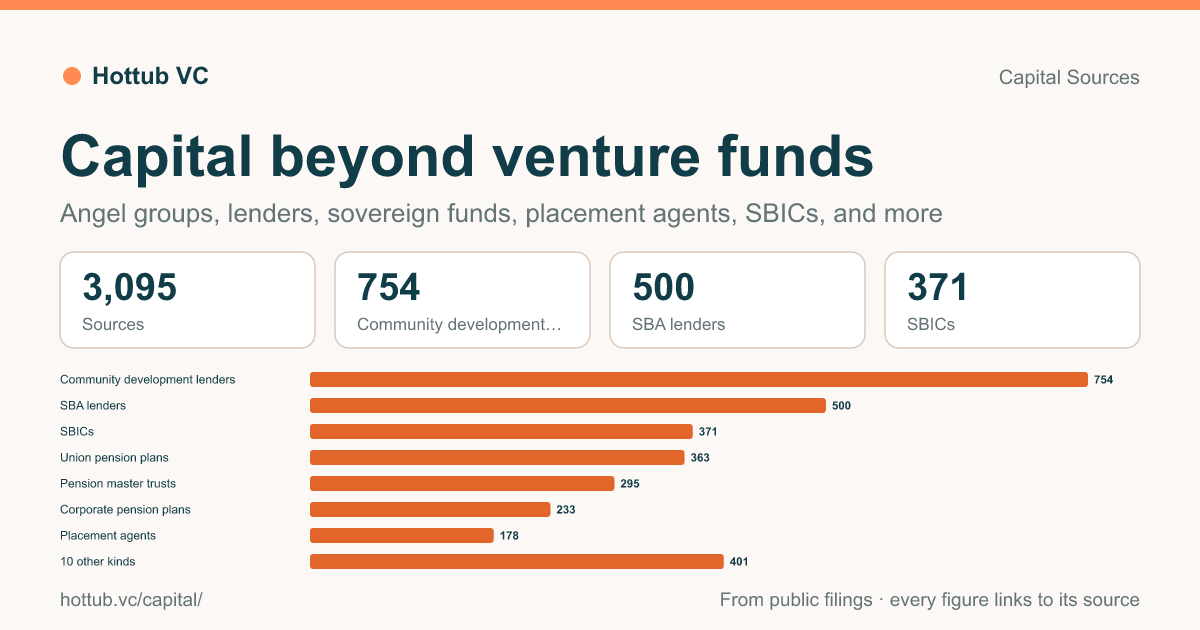
For a post, a deck, or a note to your partners: image (PNG) · vector (SVG).